






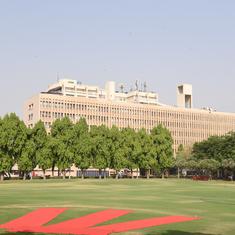




Harish Rana, first in India to be allowed passive euthanasia, dies
The 31-year-old died at the All India Institute of Medical Sciences in Delhi, two weeks after the Supreme Court allowed withdrawal of life support.

Harish Rana, the first person in India to be granted permission for passive euthanasia by the Supreme Court, died at the All India Institute of Medical Sciences in Delhi on Tuesday, The Indian Express reported.
Rana died at 4.10 pm on Tuesday, the hospital stated. He had been in a permanent vegetative state since 2013.
The court had, on March 11, allowed life support to be withdrawn for the 31-year-old. The order had been passed on a plea filed by the family of Rana, who suffered a severe traumatic brain injury in August 2013 after falling from the fourth floor of a building in Chandigarh.
This was the first instance in which the court’s directions on passive euthanasia, laid down in a 2018 judgement, had been applied.
Three days after the court’s ruling, Rana had been moved from his home in Ghaziabad to the All India Institute of Medical Sciences.
Also read: From Aruna Shanbaug to Harish Rana, India’s long reckoning with the right to die with dignity
In 2018, a five-judge Constitution bench of the Supreme Court had recognised and given sanction for passive euthanasia, and allowed living wills or advance directives.
In that judgement, the court had ruled that the right to life under Article 21 of the Constitution includes the right to live with dignity. The court had held that the constitutional right includes the smoothening of the process of dying in case of a terminally ill patient or a person in a persistent vegetative state with no hope of recovery.
Rana’s family had approached the court seeking permission to withdraw life-sustaining treatment in the form of clinically assisted nutrition and hydration administered through a PEG tube.
A Percutaneous Endoscopic Gastronomy tube is a device inserted through the abdominal wall directly into the stomach to deliver nutrition, fluids and medication.
On March 11, the court had noted that continuing the treatment was only prolonging Rana’s biological existence without any therapeutic improvement. It also observed that the primary and secondary medical boards, along with Rana’s parents, had reached the opinion that the clinically assisted nutrition and hydration should be discontinued as it was not in the best interest of the patient.
The court stated that when the medical boards have certified withdrawal of life support, there was no need for the court to intervene.
However, it added that since this was the first case to reach the court, it was appropriate to examine the matter.
It also recommended that the Union government bring in a comprehensive legislation on passive euthanasia.
